BUSINESS.GAME
Start with one shop. End up in orbit.
{{ saveMetaLine }}
BUSINESS.GAME
A business simulator — seven days, real books
Pick a business. Survive the week. End it in the black — the board meets Sunday night.
{{ c.kind }}
sells {{ c.sells }}
{{ c.diff }}
{{ c.desc }}
{{ s.k }}
{{ s.v }}
Days run on their own, Farmville-style — you set prices, stock up, staff up, buy attention.
Waiting is free. Speed costs money. Both are lessons. · your empire · design notes
PICK YOUR LOCATION
Location is a price you pay every week whether anyone shows up or not. — Rae
YOUR CITY · TAP A CORNER
{{ siteName }}
{{ siteBlurb }}
{{ s.k }} {{ s.v }}
{{ siteRentNote }}
Rae: “{{ siteRae }}”
← different business
{{ s.name }}
{{ s.sub }}
NAME THE PLACE
It goes on the sign, the receipts and — if this works — the second location. {{ siteName }} is waiting.
{{ signPreview }}
{{ signPreview }}
{{ domainPrev }}
{{ nameCount }}
LAUNCH CHECKLIST
{{ setupSub }}
CASH AFTER SETUP: {{ suCashAfter }}
{{ ss.t }}
Rae: “{{ ss.rae }}”
{{ op.l }}{{ op.cost }}
{{ op.s }}
Setup total: {{ suTotal }} · weekly tools billed Monday
Design notes — for review
Assumptions
Elite HS audience → respect their intelligence: real accounting terms from minute one, defined just-in-time with their own live numbers (dotted-underlined terms are clickable everywhere). One game week ≈ 12–15 min. Solo sandbox, real bankruptcy.
Mechanic → skill map
· Price stepper + kinked elasticity curve → pricing power (the board later reveals the mathematically optimal price).
· Three ad channels with measured CAC vs. gross-profit-per-visit → marketing.
· Candidates with wage/speed tradeoffs, utilization + labor % → hiring.
· Delivery lead times, bulk discounts flowing into moving-average COGS, rent paid up front → operations & working capital.
Farmville DNA, weaponized
Everything runs on timers: deliveries, ad ramps, hires starting tomorrow. You wait, or you pay to rush — and rush fees eat margin, which is itself the lesson about expedite costs.
Assessment
Sunday board meeting grades four skills from decision telemetry (not quiz questions) and shows the framework math with the player's numbers. Bankruptcy screen names the actual cash drain that killed you.
Cut from this prototype
District unlock map (teased), multi-week arc, competitors, saves, richer sound. Next steps: playtest pacing knobs (Tweaks panel has them), then Week 2 with the Uptown district + demand shocks.
BUSINESS.GAME
{{ weekLabel }} · {{ dayLabel }}
{{ clockLabel }}
{{ p.ch }}
{{ lb.ch }}
CASH
{{ cashLabel }}
{{ bizName }}
MENU — {{ menuLine }}
STOCKROOM
https://{{ domain }}
{{ annText }}
{{ logoLetter }}
{{ bizName }}
SHOP ABOUT FAQ
CART · {{ cartN }}
{{ heroLine }}
★★★★☆ {{ ratingLine }}
{{ priceLabel }}
{{ buyLbl }}
★★★★★ “{{ rev1 }}” — Maya R.
★★★★☆ “{{ rev2 }}” — Deshawn K.
{{ tc.l }}
10% OFF — JOIN THE LIST
Refund policyTermsContact© {{ bizName }}
SOLD OUT — TRAFFIC STILL BILLING
{{ ds.k }}
{{ ds.v }}
https://{{ domainPrev2 }}
{{ logoLetter }}
{{ bizName }}
BOOK A CALL →
{{ agHero }}
CASE STUDY
{{ ac.t }}
{{ ac.m }}
★★★★★ {{ agTestiQuote }}
{{ pc.name }}
{{ pc.n }}
{{ pp.text }}
{{ hc.k }} {{ hc.v }}
{{ t.k }}
{{ t.v }}
{{ t.sub }}
RAE · your mentor, unfortunately
{{ mentorText }}
BREAK-EVEN TODAY
{{ beLabel }}
THE BUILD — UNIT COST
{{ dsCost }}
{{ dsCostShare }} · {{ dsLead }}
QUALITY
{{ dsQ }}
/ 10
{{ dsCohLabel }} · {{ dsCohPct }}% {{ dt.t }}
Rae: “{{ dsJudgeVerdict }}”
She would price it {{ dsJudgePrice }} Angle: {{ dsJudgeAngle }}
Rae: “{{ dsVerdict }}”
{{ sl.label }}
{{ sl.chosen }} ✎ CUSTOM
{{ sl.sub }}
{{ sl.qPips }}
{{ sl.chev }}
{{ dsMarketLabel }}
{{ op.name }}
{{ op.supLine }}
{{ op.specLine }}
{{ op.qLine }}
{{ op.desc }}
✎ DESCRIBE YOUR OWN
Current: {{ dsCustomPart }}
Rae calls the supplier market and prices whatever you describe.
{{ dsBusyLabel }}
On sale now: {{ dsLiveName }} — {{ dsLiveDesc }}. New stock orders use the new build; what is on the shelf was made the old way.
price per {{ unit }}
{{ priceLabel }}
{{ refLbl }} {{ refLabel }}
Gross margin: {{ priceLabel }} − COGS {{ cogsUnitLabel }} = {{ marginUnitLabel }} per {{ unit }} ({{ marginPctLabel }})
Demand right now: {{ demandLabel }}{{ demandSuffix }} Elasticity {{ elastSuffix }}
{{ priceTip }}
on hand
{{ invUnits }}
{{ unitsWord }} @ {{ avgCostLabel }} avg
days of cover
{{ coverLabel }}
burn ≈ {{ burnLabel }}/day
{{ o.label }}
{{ o.sub }}
Delivery takes {{ leadLabel }} of open hours. Ordering ties up working capital — cash leaves now, sells later. Bulk lowers your average COGS.
{{ backlogLine }}
in transit
{{ pd.label }} · arrives {{ pd.eta }}
buzz — who's thinking of you
{{ buzzSplit }}
organic (word of mouth, decays to a baseline) paid (fades in hours)
{{ ch.name }}
{{ ch.desc }}
{{ ch.status }}
CAC so far: {{ cacLabel }} · gross profit per sale: {{ gpVisitLabel }}
{{ cacVerdict }} LTV is the number that decides if ads are an investment or a donation.
{{ teamNote }}
utilization
{{ utilLabel }}
labor % of revenue
{{ laborLabel }}
healthy ≈ 18–38%
your crew
{{ m.name }} {{ m.note }}
{{ m.sub }}
MORALE
candidates
{{ cd.name }}{{ cd.wage }}{{ cd.speed }}
{{ cd.vibe }}
RESUME · {{ cd.exp }}
+ {{ cd.str }} · − {{ cd.wk }}
{{ crewNote }}
{{ clientSummary }}
{{ crw.name }} {{ crw.risk }}
{{ crw.sub }}
Retainers bill weekly and consume delivery hours. Keep utilization between 60–85% — past 100%, clients quietly start interviewing your competitors.
https://{{ domainPrev2 }}
{{ bizName }}
{{ agHero }}
{{ ac.t }}
{{ ac.m }}
BOOK A CALL →
★★★★★ {{ agTestiQuote }}
{{ addonLine }}
{{ buildNote }}
{{ bi.name }} {{ bi.cnt }}
{{ bi.desc }}
{{ bt.name }}
{{ bt.desc }}
Seats are inventory too — dwell time decides how hard they work. Furniture lands on your balance sheet, not your P&L — until you sell it back at half price.
income statement — week to date
{{ r.l }} {{ r.v }}
balance sheet — right now
{{ r.l }} {{ r.v }}
Change in equity since Monday = your net income. That is the whole scoreboard.
SUNDAY, 9:00 PM — {{ bizName }}
BOARD MEETING — {{ bdWeekLabel }}
Revenue {{ bdRev }} · Net income {{ bdNet }} · Cash {{ bdCash }}
OVERALL{{ bdGrade }}
{{ s.g }}
{{ s.name }}
{{ s.note }}
{{ fc.title }}
{{ fc.body }}
Rae: “{{ bdVerdict }}”
BUSINESS.GAME
{{ eraLabel }}
{{ eraBlurb }}
WHAT YOU ARE WORTH
{{ netWorth }}
{{ cashLine }}
DRAG TO SPIN · TAP A SITE
{{ os.name }}
{{ os.sub }}
NOTHING HERE YET
Open your first shop, or type anything you want to build and it gets priced honestly.
{{ selName }}
{{ selKind }} · {{ selSite }}
REVENUE
{{ selRev }}
NET
{{ selNet }}
VALUE
{{ selValue }}
LAUNCH ANYTHING
Rae is offline right now, so she cannot price a new idea. The six trades below still open normally.
Anything you can describe. At your size that realistically means {{ eraCan }}.
{{ lName }}
{{ lKind }} · {{ lPlace }}
NOT YET
{{ lWhy }}
NOT A BUSINESS
Rae: “{{ lVerdict }}”
CAPEX
{{ lCapex }}
REVENUE
{{ lRev }}
NET
{{ lNet }}
RISK
{{ lRisk }}
Lesson: {{ lLesson }}
{{ xr.n }} {{ xr.v }}
OPEN A BUSINESS
Six hands-on businesses you can run yourself in {{ launchSiteName }}.
NEXT ERA · {{ nextEraName }}
{{ netWorth }} of {{ nextEraNeed }} net worth
THE LOG
Nothing has happened yet.
{{ lg.txt }}
THE PORTFOLIO
{{ vr.name }}
{{ vr.kind }} · {{ vr.place }}
REVENUE
{{ vr.rev }}
NET
{{ vr.net }}
RISK
{{ vr.risk }}
MASTERY TREE
{{ treeEarned }} earned — every unlock is passed, never bought
{{ nd.name }}
{{ nd.tier }}
{{ nd.state }}
{{ nd.fx }}
{{ nd.progTxt }}
{{ tierMark }}
{{ totalLevelLabel }}
{{ totalXpLabel }} · {{ tierName }}
{{ tierNext }}
HIGHEST
{{ bestName }} {{ bestLv }}
{{ sk.glyph }}
{{ sk.name }}
{{ sk.rank }}
{{ sk.lv }}
/ 99
{{ sk.xp }} xp
{{ sk.next }}
{{ sk.fxName }}
{{ sk.fxVal }}
{{ sk.desc }}
THE CASE — {{ trophyCount }}
Every object here had to be earned by doing the thing.
{{ tr.name }}
{{ tr.rar }}
{{ tr.desc }}
BUSINESS.GAME
{{ distName }}
{{ distTag }} · {{ distCount }}
SITE NET
{{ distNet }}
DRAG TO PAN · TAP A PLOT
HOW THIS CITY WORKS
The corners that glow are empty plots. Tap one and pick a business from the BUILD panel — or drag a business card straight onto a plot. Tap any of your buildings to step inside and run it.
{{ selName }}
{{ selKind }}
REVENUE
{{ selRev }}
NET
{{ selNet }}
VALUE
{{ selValue }}
{{ buildTitle }}
{{ buildBlurb }}
INSOLVENT.
{{ bustWhen }} — the till is empty and the obligations are not.
where the cash went
{{ d.l }}{{ d.v }}
Rae: “{{ bustLesson }}”
{{ tipTitle }}
{{ tipBody }}
computed live from your books
{{ composeTitle }}
{{ composeBlurb }}
Good copy multiplies this channel all week. Bad copy multiplies it too — downward.
{{ compGrade }}
Rae: “{{ compVerdict }}” {{ compScore }}
{{ d.k }}
{{ d.fb }}
Fix first: {{ compTip }}
Effect: {{ compEffect }}
RETAINER AGREEMENT
weekly services · auto-renewing
Between: {{ bizName }} (“Agency”) and {{ agreeClient }} (“Client”).
Scope of work: {{ agreeScope }}
Service allocation: {{ agreeHrs }} hours per week of senior delivery time.
Fees: {{ agreeFee }} per week, billed daily pro-rata, collected each morning.
Term: renews weekly, automatically.
Termination: either party, any time, effective immediately. (This clause is why churn exists.)
Response SLA: Agency responds to Client messages within one business day.
signed — {{ bizName }}signed — {{ agreeClient }}
Rae: “Read the termination clause twice. Recurring revenue is rented, not owned — and the rent is called service quality.”
{{ chalTitle }}
SKILL CHECK
{{ chalQ }}
Pass to unlock the upgrade for this run. Your real numbers, your real skill.
CORRECT — LICENSE EARNED
{{ chalExplain }}
NOT QUITE
{{ chalExplain }}
ASK RAE
{{ aiStatus }}
{{ cm.txt }}
Rae is doing the math…
{{ ts.text }}
▼ ABOUT THE GAME

business.game: a free online business simulation game you can play in your browser

business.game is a free business simulation game that runs entirely in your web browser. There is no download, no signup, and no paywall. You open a small shop in a pixel-art city, set your prices, order stock, hire a crew, and read your own books — and if the numbers work, you grow that one corner shop into a city, then an empire, then something a great deal larger. The game simulates real unit economics: every cup, pair, and order in it has a cost, a price, and a margin, and the difference between those numbers is the whole game.

Most tycoon games hand you upgrades for playing long enough. Here, every meaningful upgrade is earned by passing a skill check on your own live numbers — a break-even question about your shop, a customer-acquisition question about your ad spend. You cannot memorize the answers, because the answers change with how you play.

▶ PLAY FREE — NO SIGNUP

How the business simulation works

A run starts with one business and a small float of cash. Time moves in minutes; a full trading day passes in about a minute of real time, and a week ends in a board review that grades your pricing, marketing, operations, and people decisions with the actual arithmetic shown. Nothing in the report is vibes: if the board says your margin was 61%, you can check it against your own books, line by line.

Set a price against real demand

Demand in business.game follows a constant-elasticity curve, the same model used in real price-elasticity analysis. Underprice and you leave money on every sale; overprice and walk-ins fall off a cliff past the kink. The espresso bar opens at a $4.50 street average with $1.10 direct costs — where you take it from there is the first real decision of the game.

Manage stock, cover, and lead times

Inventory arrives on lead times measured in game-hours, bulk packs are cheaper per unit but tie up cash, and rush orders cost a fee that the game will politely describe as poor planning. Days of cover — how long your shelf lasts at the current sales rate — is the operations number the game teaches you to watch, because a sold-out afternoon is rent paid for customers you turned away.

Buy attention, then keep it

Buzz decays every day. Flyers, local ads, influencer posts, and word of mouth each have a cost and a half-life, and the game tracks blended customer-acquisition cost against gross profit per visit. If a channel pays back in under two visits, the board will tell you that is buying money at a discount — and if it does not, it will tell you that too.

Hire, train, and keep morale up

Crew members have wages, speed, and morale. A queue that outruns your counter loses customers you already paid to attract; a crew standing idle is labor cost with nothing to do. Utilization between those two failure modes is the people game.

Survive the weekly board review

Every Sunday the board grades the week A through F across four disciplines, with the arithmetic on the table. Rent ratchets up 6% a week, a competitor across the street takes a growing slice of walk-ins, and one seeded event per week — a supplier repricing, roadworks, a labor-market squeeze — keeps a good playbook from running on autopilot.

"In this business you get eleven customers a day and each one pays your rent or doesn't. No sloppy pricing." — Rae, the in-game mentor, on opening day of a streetwear shop

Seven businesses you can run, from a coffee cart to a watch brand

Each venture in business.game is a different economic shape, not a reskin. Margins, traffic, lead times, and failure modes all change, which is why a pricing strategy that carries the espresso bar will quietly bankrupt the watch brand.

Pixel-art storefronts from the business simulation game: espresso bar, bubble tea truck, streetwear resale shop, e-commerce warehouse, plush toy startup and marketing agency
The seven ventures and the lesson each one forces
BusinessTypeEconomic shapeWhat it teaches
Espresso barRetail storefrontHigh volume, honest margins, brutal morning rushThroughput and break-even discipline
Bubble tea truckRetail truckCheap rent, fad-driven demand, 3pm spikeBuzz management and timing
Streetwear resaleRetail storefrontFat margins, thin traffic, high rentEvery-customer-matters pricing
E-commerce storeOnline shopBought traffic, designed conversion, shipping deadlinesCAC, conversion, and fulfillment
D2C plush startupOnline hardwareManufacturing batches, air-freight rush fees, review-driven viralityWorking capital and lead times
Watch brandOnline brandYou source every part — case, movement, dial, band — and sell the storyProduct coherence and brand pricing
Marketing agencyServicesNo product, no stock; you sell hours and outcomes on retainerPipeline, delivery, and churn

Design the product itself

The deeper ventures include a full product studio. The watch brand sources cases, movements, dials, bands, and crystals from a supplier marketplace with minimum order quantities, lead times, and quality tiers — or you describe a part in plain words ("a dragon in relief, made of gold") and the game's AI sources and prices it. Product coherence is scored, and a build that tells one story earns pricing power that a parts-bin build never will. The espresso bar sources beans the way a real importer does; the agency picks a niche and builds a portfolio.

A skill tree where every unlock is passed, never bought

Progression runs on two tracks. Twelve skills — pricing, margin, operations, people, craft, audience, product, finance, sales, logistics, engineering, capital — level from 0 to 99 on an experience curve deliberately borrowed from the slowest, most respected grind in gaming, so the top of the table is a genuine commitment. Every level is earned in play and every level does something: price tolerance, supplier costs, delivery leads, crew speed.

On top of that sits the mastery tree. Licenses gate the sharpest tools — bold pricing beyond the street band, bulk stock orders, the influencer channel, a bigger team — and each license is a skill check computed from your own live numbers. Beyond the licenses come objectives you must achieve in play (close a day at 70%+ gross margin with 20+ sales, hold a full day of stock cover two days running) and capstones that change how your whole empire runs, like standing orders that manage stock automatically and a second-site playbook that cuts every future venture's opening cost by 20%.

"Training raises the ceiling permanently. Lunches rent speed; skills own it." — Rae, on why the TRAIN button beats the pizza budget

Trophies worth screenshotting

The trophy case tracks the run: first profitable week, an A-grade board, surviving a bankruptcy scare, your first million, and rarer things much further up. Levels, trophies, and board grades are designed to be shown off — the screenshot is the brag.

Pixel-art achievement trophies from business.game including award plaques, magazine covers and collector watches

A living pixel city that grows with your empire

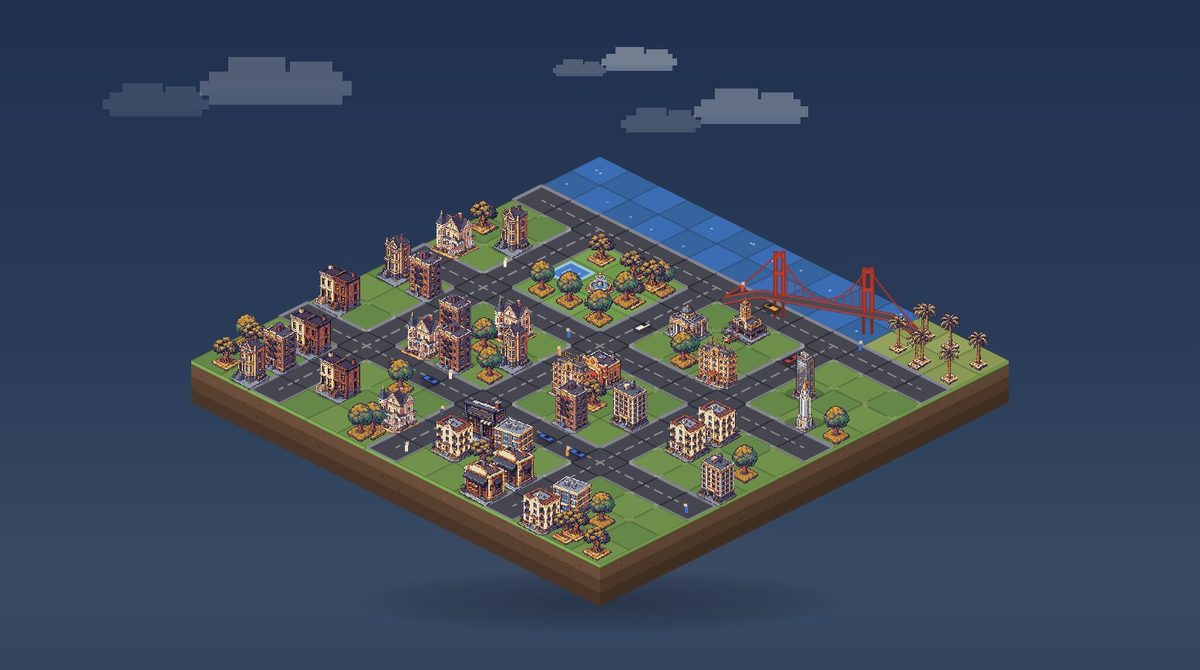
Your businesses live on real plots in a procedurally built isometric city — traffic, pedestrians, a bridge, a park, weather in the sky. Tap a glowing plot to build; tap a storefront to walk in and run it. As your net worth crosses each era threshold the map widens: new districts, new cities with their own rents and traffic, and eventually a world map where the ambitious late game stops being metaphorical — satellites, launch pads, and an asteroid with your name on it.

Isometric pixel-art city from the free online business simulation game business.game, with shops, roads, cars and a suspension bridge

The AI layer is not a chatbot bolted on. Rae, the in-game mentor, reads your actual books before speaking; the copy grader scores the ad you wrote and multiplies your campaign by it; and the venture engine prices anything you can describe — pitch a niche magazine, a ferry line, or an orbital junk-removal service and the game will cost it, staff it, and let you run it.

Business skills the game actually teaches

business.game was built on a simple bet: a simulation can teach real business skills faster than a textbook, because the numbers are yours and the consequences arrive in minutes, not semesters. These are the concepts the game exercises, each one applied rather than defined:

  • Break-even analysis. Every day the HUD shows how many units cover that day's fixed costs — the same break-even arithmetic a real operator runs, updated live as you change prices.
  • Gross margin. Price minus direct cost, per unit and per week, and why a 78% margin coffee still loses money under a bad rent. See gross margin if the term is new; the game will make it muscle memory.
  • Price elasticity. The demand curve punishes overpricing non-linearly, exactly like the real world's kinked response to a price past what the street will bear.
  • Customer acquisition cost and LTV. Every marketing channel reports blended CAC against gross profit per visit, and the board compares it to what a regular is worth over their lifetime.
  • Working capital. Bulk packs are cheaper and rush fees are expensive, so cash tied up in stock against cash kept for payroll becomes a decision you make daily.
  • Unit economics of hiring. A hire is modeled as capacity: what the queue costs you in lost sales against what the wage costs you in certainty.
  • Churn and service quality. The agency teaches that recurring revenue is rented, not owned — overservice one client and another quietly leaves.
  • Reading a P&L. The BOOKS tab is a real weekly profit-and-loss: revenue, COGS, wages, rent, marketing, fees, refunds. The game's accounting is double-checked by an automated test that fails the build if equity ever drifts from net income.
"Add-ons: the second item rides on rent you already paid. Nearly pure margin." — Rae, explaining attach rate better than most retail consultants

Why play a business simulation game at all?

Business simulation games are one of gaming's oldest genres — from 1973's Lemonade Stand through Capitalism, RollerCoaster Tycoon, Game Dev Tycoon, and the modern colony-and-logistics school — because running a system that pushes back is inherently satisfying. The genre's open secret is that the best ones are accidentally educational: a generation of players learned supply chains from spreadsheet games about space trucking.

business.game runs that logic on purpose. It keeps what makes tycoon games fun — visible growth, a city that fills in, numbers that go up because you made them — and swaps the usual fake economy for a real one. The result reads like a game and compounds like a course:

  1. Hours one to two: you learn the till — price, stock, staff, and the rhythm of a trading day.
  2. Hours three to five: the board reviews start landing; you pass your first licenses and stop pricing by feel.
  3. Hours six to ten: multiple ventures, standing orders, a product line you designed yourself, and the first era jump into a bigger map.
  4. Beyond: the empire game — cities, sectors you invent, and the long climb from magnate to the launch pad.

What makes it different from other free business games online

For teachers, students, and anyone learning entrepreneurship

business.game works as a classroom companion for entrepreneurship, economics, and business-studies courses because every mechanic maps to a syllabus concept and every claim the game makes about your performance is shown with its arithmetic. It runs in a browser on school hardware, needs no accounts or installs, and a single lesson's worth of play produces a week's worth of numbers to discuss: break-even points, margin structures, CAC payback, and one graded board review per student, each different because each shop was run differently.

Suggested classroom exercises

  • Run the same espresso bar at $3.50, $4.50, and $6.00 for one in-game week each and chart walk-ins against margin — elasticity as a lived experience.
  • Give students one $160 influencer post and have them defend the CAC math in the next board review.
  • Have half the class take the operations license check before day three, and compare stockout hours with the half that did not.

The mentor's advice is generated against each student's own state, so no two playthroughs produce the same lecture — a property teachers will recognize as the difference between a worksheet and a tutor.

Frequently asked questions

Is business.game really free?

Yes. The full game is free to play at business.game — no purchase, no premium currency, no ads sold against your attention. It is a portfolio-grade production built to be played.

Do I need an account or a download?

No. The game runs entirely in your browser and saves automatically to your device. You can close the tab mid-week and resume exactly where you left off.

Does it work on phones and tablets?

Yes. The interface is built for touch as well as mouse — tap to build, drag to pan the city, and every panel reflows for small screens. A desktop browser gives the most comfortable view of the city.

What kind of game is it — idle, tycoon, or simulation?

It is an active business tycoon simulation, closest in spirit to the classic tycoon school. Time only moves while you play, decisions matter minute to minute, and there are no idle mechanics: nothing accrues while you are gone, because the game is about running the business, not watching it.

How long does a run take?

Your first in-game week — the full arc from opening day to your first board review — takes roughly 15 to 20 minutes. A run to the first era threshold is an evening. The full climb through every era and a maxed skill table is designed to take a very long time on purpose.

What does the AI actually do in the game?

Three jobs. Rae, the mentor, reads your live books and speaks to your actual situation. The copy grader scores ad copy you write yourself and applies the multiplier to your campaign. The venture engine prices, staffs, and simulates any business you can describe in a sentence, which is how the late game lets you launch more or less anything.

Can I lose?

Yes. Run out of cash with payroll due and the game closes your doors — with a diagnosis of which decision sank you, because a bankruptcy you understand is worth more than a win you don't. You can always start a new run.

Is there multiplayer or a leaderboard?

Not currently. The game is single-player; the competitive layer is the share-worthy artifacts — total level, trophies, board grades, and net-worth milestones.

Can schools use it?

Yes, freely. It needs only a browser, no student accounts, and no installation, which makes it usable on locked-down school hardware. The section above for teachers has ready-made exercises.

Who made business.game?

It is designed, built, and operated by a solo developer as a production-grade demonstration that a game can be genuinely fun and genuinely instructive at the same time — with AI used in every layer of both the game and its development.

▶ START YOUR FIRST BUSINESS